
Hero's Aeolipile: The First Steam Engine
A spinning steam sphere from Roman Egypt. Hero of Alexandria described a sphere spun by jets of steam about 2,000 years ago, plus vending machines, wind organs and automatic stage shows.
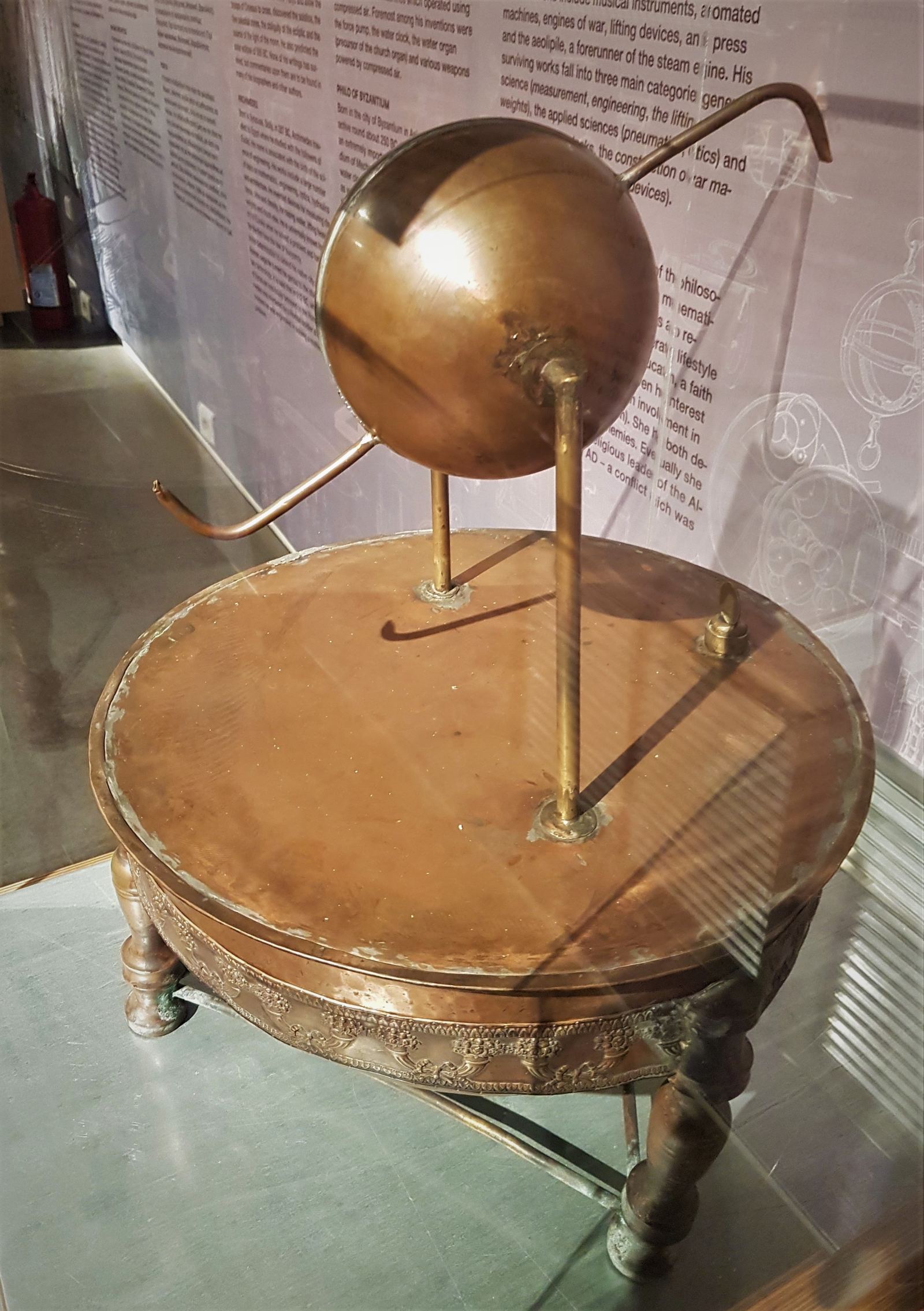
A reconstruction of Hero's aeolipile: Gts-tg, CC BY-SA 4.0
A sphere that spins on steam
Picture a hollow metal ball balanced on two pipes above a pot of water. Light a fire under the pot and steam rises through the pipes into the ball, then rushes out through two bent nozzles pointing in opposite directions. The jets push back on the ball, and it starts to whirl. That is the aeolipile, and it is the earliest steam-powered device we have a written record of.
It was described by Hero of Alexandria, an engineer and mathematician who worked in Roman Egypt. His exact dates are uncertain, but an eclipse mentioned in one of his books points to the first century CE. The Roman architect Vitruvius had already written about devices called aeolipiles a little earlier, and Hero drew on a long Alexandrian tradition of air and water machines going back to the inventor Ctesibius.
Why it did not start an industrial revolution
The aeolipile works on the same reaction principle that drives a rocket or a lawn sprinkler. Yet nobody hooked it up to do real work. It wasted most of its steam, it could not easily turn a load, and the ancient world ran on human and animal muscle. For Hero it was a demonstration of the power of air and heat, a wonder to amaze visitors rather than a factory engine.
Historians still enjoy asking what might have happened if someone had pushed the idea further. In the end, practical steam power had to wait for the engineers of the 1700s.
A workshop full of wonders
The steam sphere was only one entry in Hero's catalog. He described what is often called the first vending machine: a temple dispenser for water used in ritual washing. Drop a coin in the slot and it landed on a small pan on a lever. The weight tipped the lever, which opened a valve and let water flow until the coin slid off and the valve closed again.
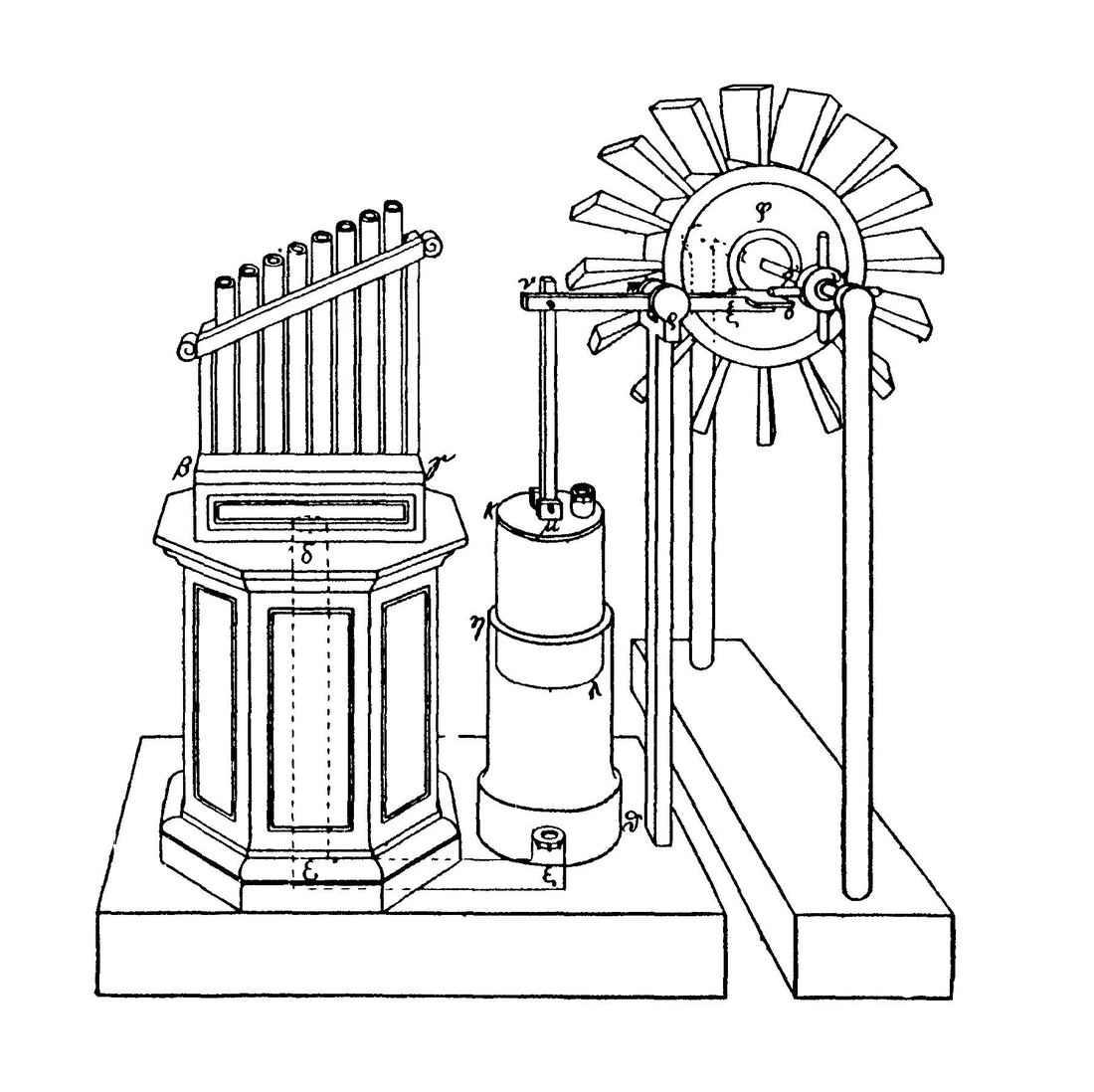
He also sketched an organ whose air pump was driven by a windmill wheel, the earliest known description of wind powering a machine. There were self-opening temple doors, a fountain that seemed to run by itself, and a fully mechanical puppet theater, driven by ropes and a falling weight, that could perform a short play on its own.
The mind behind the machines
Hero was not just a gadget maker. His books covered surveying instruments, mirrors, lifting machines and geometry, including the famous formula for finding the area of a triangle from its three sides, still taught as Heron's formula. Copied and recopied by hand for centuries, his writings carried the playful, practical spirit of Alexandrian science all the way to the Renaissance.
- A reconstruction of Hero's aeolipile: Gts-tg, CC BY-SA 4.0
- Hero's wind-powered organ, in a 19th-century drawing: W. Schmidt, Public domain
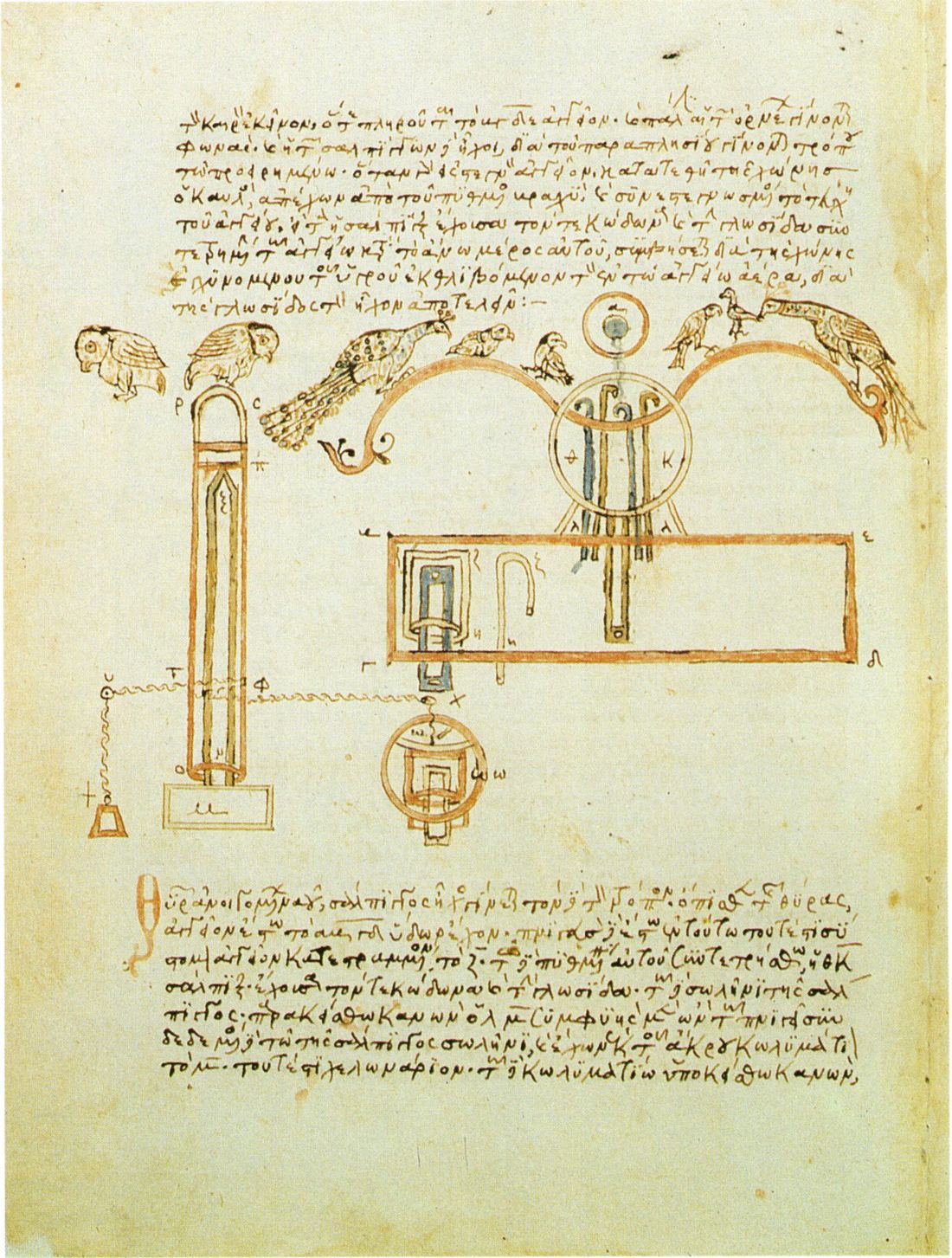
- A manuscript page from Hero's Pneumatica: Hero of Alexandria, Public domain
Text written by Ancient Visionary.
← The Antikythera MechanismZhang Heng's Earthquake Detector →

.jpg)

